
MCP vs REST API: Choose the Right Workflow
You open a chat interface, describe a spring promotional campaign, and ask for a tracked short URL. The system returns a formatted link with source, medium, and campaign tags attached. How that request reaches the link-creation server shapes your automation architecture. In short, use a REST API when your application controls the operation and its fields, and use MCP when an AI host must interpret a request and select a tool. Trnqify illustrates the split: its AI UTM Assistant suggests tags from a plain-language brief, while REST and MCP are separate paths for moving those tags into a production system.
MCP vs REST API: The Short Answer
The architectural choice depends on who selects the action and validates the data. REST serves as the standard for application-controlled workflows. A marketing system sends an explicit JSON payload to an endpoint, receives a structured response, and handles any errors according to programmed rules.
MCP gives the model control over tool calls, while a host’s client uses the server’s declared capabilities to determine which tools are available. The MCP Python SDK first steps guide describes tools as model-controlled and resources as application-controlled.
These paths are not mutually exclusive. An agent can translate a messy email draft into proposed UTM parameters, which the host system then passes through strict application logic before executing a link-creation tool. This hybrid approach gives users the flexibility of natural language while maintaining the data integrity of a hardcoded integration.
MCP vs REST API: Side-by-Side Comparison
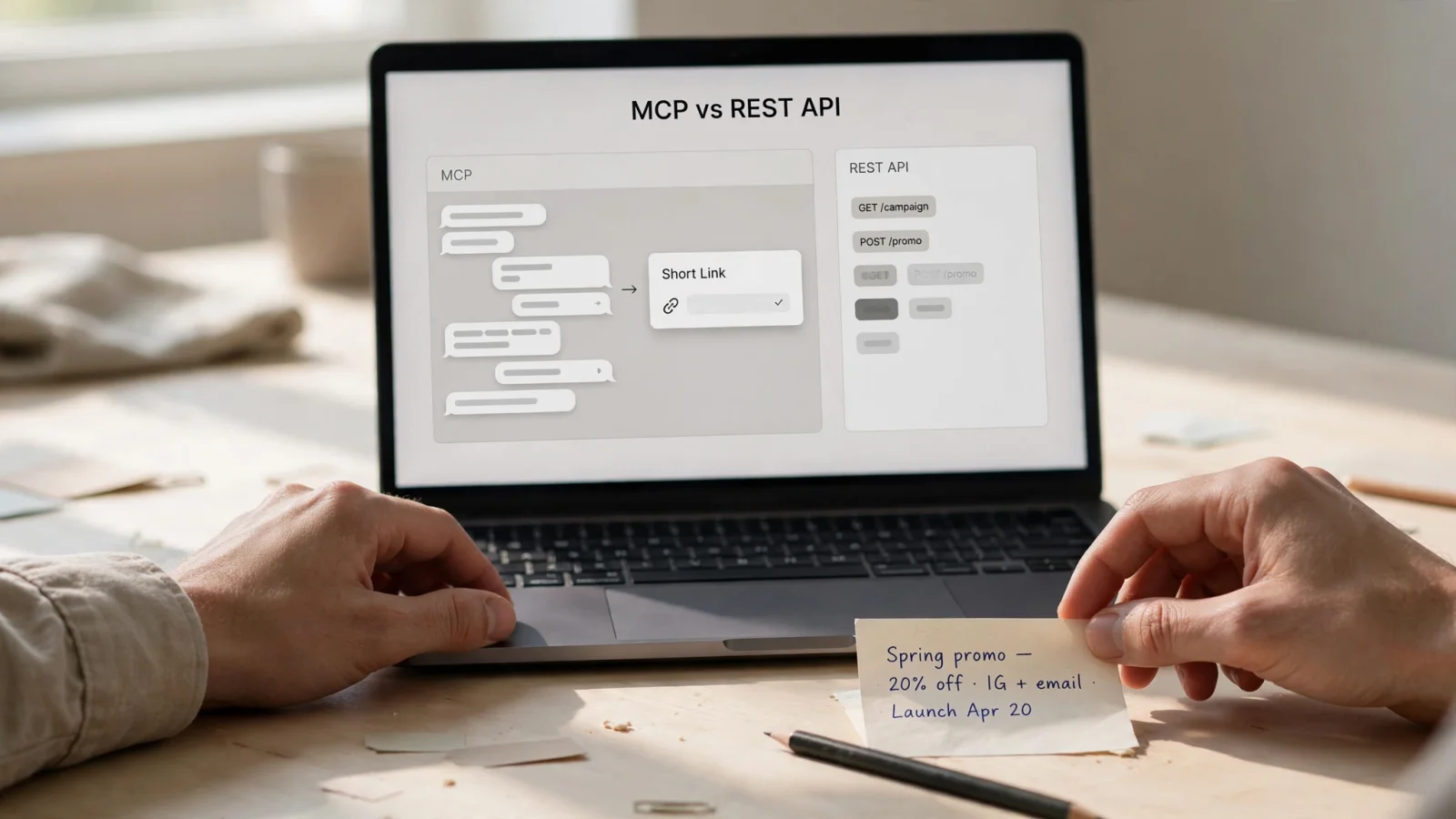
Evaluating both integration paths side by side clarifies their operational boundaries. While REST relies on a direct call to a service’s HTTP interface using explicit request fields, MCP provides a standardized way for a host to expose capabilities to an agent.
| Decision Point | REST API | Model Context Protocol (MCP) |
|---|---|---|
| Who drives the workflow? | The application calls a known operation with explicit inputs. | An MCP client can list the tools a server advertises and call one by name. |
| Best fit | Repeated workflows with known fields, such as creating links from a campaign record. | Conversational requests where a user describes a goal and the agent needs an available tool. |
| Where rules belong | In application logic that validates fields, sequences calls, and handles results. | In the tool definition and implementation, with business rules enforced by the server. |
| Main advantage | The developer controls the exact steps and data passed to each operation. | A model-facing interface makes supported actions discoverable from compatible AI hosts. |
| Main design concern | The application team must build their own interface or orchestration around the API. | Tool availability does not guarantee correct tool selection or valid inputs. |
| Trnqify example | A marketing system sends structured campaign fields as part of an established workflow. | A marketer asks an AI assistant to create a campaign link from a plain-language brief. |
MCP does not replace a REST API. You can use REST directly from a background application, expose a tool through MCP for an agent, or build an MCP tool that uses an existing REST API behind the scenes. MCP SDKs often use web-API analogies to explain concepts, comparing resource reads to GET requests and tool calls to POST requests. These analogies can help developers grasp the protocol, but they do not make the protocols structurally equivalent.
Because tool availability under MCP does not guarantee correct selection or valid inputs, an agent connection needs to account for hallucinated parameters and misunderstood instructions. Neither approach offers a built-in advantage for speed, safety, or reliability. Performance and security characteristics depend on the underlying implementation and network topology.
Choose REST for Fixed, Application-Controlled Workflows
REST suits structured campaign data and repeatable processes. When a marketing automation platform generates a new promotional email, the destination URL and UTM parameters already live in the database, so the system doesn’t need a language model to infer the campaign name. Application code formats those known values, calls the link-creation operation, controls the sequence, and processes the returned short URL.
This path works best when determinism matters most. Determinism in this context means control over the sequence of steps and the exact inputs provided, rather than a mathematical guarantee provided by the HTTP protocol itself. The application knows which endpoint to hit, what schema to follow, and how to handle a rate-limit error or network timeout.
Consider a custom CMS pushing approved campaign fields to a link-management backend. The application logic validates the destination URL format, checks the UTM fields against an internal company taxonomy, and fires the request. The trade-off comes in the form of development overhead, as the engineering team builds and maintains the orchestration logic, updates the integration when endpoints change, and designs user interfaces for marketing teams to input the data.
Choose MCP for Agent-Led Link Tasks
MCP fits environments where the user request begins in natural language and the execution path is unknown at the start. Working inside a compatible AI host, you might ask for a link to a product page without specifying the UTM parameters. The host makes tools available to the agent, allowing it to evaluate the request, ask clarifying questions, and eventually select a link-creation tool.
This workflow excels at handling ambiguity. The agent infers that a request for a “Twitter promo link” requires utm_source=twitter and utm_medium=social (or x, if that’s the source value your team has standardized on). You then review the suggested tags and the generated short link before sharing it with an audience. Because the entire interaction happens within a conversational interface, it removes the need for a dedicated form or custom dashboard.
When implementing this pattern, check the connection mechanics against the specific SDK you use. The 2026-07-28 revision of the official specification replaced the connection lifecycle with a stateless core: no initialize handshake and no protocol sessions, with each request carrying its own version and client metadata. Tool definitions should clearly explain what each parameter does and when to use the tool, because the model relies on those descriptions to decide which tool to call. Constraining inputs in the schema and enforcing business rules in server-side logic ensures that an invalid URL, or a campaign tag that breaks company naming conventions, is rejected rather than acted on.

Use Both When AI Needs Guardrails
The hybrid pattern combines the conversational flexibility of MCP with the strict execution control of REST. This architecture supports requests that begin in natural language but require governed execution before they touch a production database.
Consider an illustrative prompt for this scenario: “Create a short link for our spring sale landing page in an organic LinkedIn post. Suggest utm_source=linkedin, utm_medium=social, and utm_campaign=spring-sale-2026. If the campaign name conflicts with our approved naming convention, ask before creating the link. Return the final tagged destination and the short URL.”
In a hybrid workflow, the system manages this request in distinct stages:
- Interpretation: The agent parses the natural-language brief and maps the requested values to structured fields.
- Validation: Application logic intercepts the proposed fields before they reach the link-creation tool, checking the destination URL for security threats and validating the tags against an approved taxonomy.
- Execution: Once the application logic clears the parameters, it performs the operation through a supported API.
- Review: The system returns the generated link to the user interface for final approval.
Google Analytics publishes a campaign field reference for GA4 configuration, where campaign_source identifies a search engine, newsletter name, or other source, campaign_medium identifies a medium such as email or cost-per-click, and campaign_name identifies a specific product promotion or strategic campaign. The values in the prompt serve as common defaults, while teams enforce their own specific naming conventions during the validation phase.
An adjacent architecture idea is a multi-agent handoff, described in Trnqify’s guide to connecting URL shortening with AI agents. One agent specializes in interpreting the marketing brief and passes a structured payload to a second agent dedicated to link management. This setup keeps system prompts focused and reduces the likelihood of parameter hallucination, but it still requires application-layer validation to ensure data integrity.

Trnqify: Separate Tagging, Integration, and Measurement
Trnqify separates the act of suggesting campaign tags from the integration path used to create the link and the mechanism used to measure the resulting clicks. The in-app AI UTM Assistant serves as a tagging aid by reading a plain-language description and proposing a set of UTM parameters for you to review. Moving those parameters into a short link then happens through the web interface, the REST API, or an MCP tool connection.
The integration capabilities scale across the service tiers. Every plan, including Free, includes unlimited links and detailed click analytics, though Free short links show an interstitial page once they pass 1,000 clicks in a month. The paid tiers add direct redirects, API access, and agent integrations for automated workflows. Further up, the Pro plan offers custom slugs, custom domains, and city-level analytics for granular campaign reporting. Webhooks are also available for event-driven architectures.
Once you distribute the link, the measurement architecture takes over. Trnqify records shared-link clicks at redirect time, without cookies or tracking scripts on the redirect. The approach to redirect-time click analytics logs the event when the user passes through the short URL server. This method counts the interaction without selling user data and provides an immediate signal of campaign engagement, but it cannot identify the same person across separate browsing sessions or prove downstream conversions on its own.
Verdict: Choose by Who Controls the Workflow
Choose the REST API when your application owns a fixed workflow and possesses structured inputs. An automation script pulling from a campaign database relies on strict control over execution steps, error handling, and response parsing.
Choose MCP when an agent needs to interpret a user’s request and utilize a link-management tool. Working in a chat interface, you benefit from a system that translates a vague goal into correct UTM parameters and a functional short URL.
Combine them when natural-language intent needs to pass through application-controlled validation. Using an agent to parse the request, you can apply application logic to check the taxonomy and enforce business rules before calling the final operation.
Ready to automate your campaign tagging and click measurement? Start creating privacy-first short links with Trnqify.
Frequently Asked Questions
Does MCP replace REST APIs?
They serve different roles in modern software architecture rather than competing. MCP provides a standardized interface for AI models to interact with tools, while REST remains the standard for application-to-application communication, allowing them to coexist within the same system.
Can you use MCP and REST together?
An MCP-facing tool often acts as a wrapper that calls an existing REST API behind the scenes. This integration allows developers to expose legacy application logic to AI agents without rewriting their backend infrastructure.
Which is better for automated link creation?
REST provides the better choice for fixed, high-volume automation where the fields are known in advance. MCP serves conversational requests where an agent discovers the right action and interprets user intent. A hybrid approach works best when you need the flexibility of AI alongside the safety of hardcoded rules.
Does MCP change how Trnqify measures clicks?
The integration path used to create the short link remains separate from the measurement mechanism. Trnqify measures clicks at the moment of redirect, regardless of whether a human, an API script, or an AI agent generated the URL.
Does cookie-free click measurement identify visitors across sessions?
This method cannot identify visitors across sessions on its own. Logging a click at redirect time counts the specific engagement event, and linking that click to a persistent identity across multiple browsing sessions requires additional downstream identifiers or integration with a separate analytics platform.